Mahalaxmi Nagar (Near Sun City), Indore • Class 5–12 • Free Demo Class

The Hidden Link Between Abacus Training and Improved Concentration
Blog post description.
VIDYADHARA
2/14/20262 min read
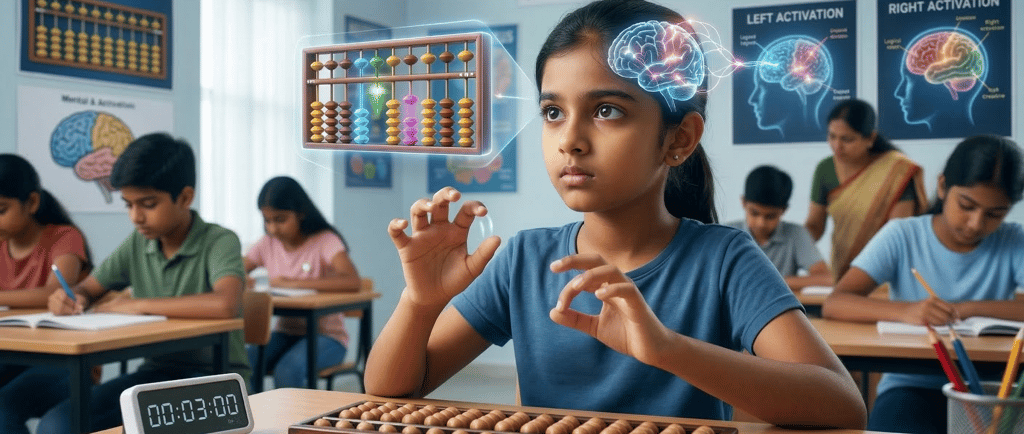
In a world filled with digital distractions, "concentration" has become the most valuable currency a student can possess. While most parents view the Abacus simply as a tool for basic arithmetic, its true power lies far beyond addition and subtraction.
At its core, Abacus training is brain gymnastics. It is one of the few activities that creates a profound "hidden link" to heightened mental focus. Here is how moving those small beads leads to a massive leap in concentration.
1. The Power of Visualization (The Mental Abacus)
The journey starts with a physical tool, but the magic happens when the tool is removed. As students progress, they are taught to visualize the Abacus in their minds.
To solve a problem like $742 + 589$ mentally, a child must:
Hold a clear image of the beads in their "mind's eye."
Manipulate those beads according to specific rules.
Track every movement without losing the image.
This process requires intense, unwavering focus. If the mind wanders for even a second, the mental image dissolves. By practicing this daily, a child’s "concentration muscle" becomes exceptionally strong.
2. Simultaneous Brain Activation
Standard school math primarily engages the left hemisphere of the brain (logic and analysis). Abacus training, however, requires both:
Right Brain: For visualization and creativity (seeing the beads).
Left Brain: For applying the logical rules of calculation.
This "whole-brain" coordination forces the student to stay deeply engaged. When both sides of the brain work in harmony, the "noise" of outside distractions is naturally filtered out.
3. Developing "Laser Focus" through Auditory Training
In Abacus classes, we often use dictation exercises. A teacher calls out a long string of numbers at high speed, and the student must calculate them instantly.
In these moments, the student cannot ask the teacher to "repeat that." They must listen with 100% intent. This builds active listening skills and a level of laser focus that carries over into their school lectures, making them more attentive students in every subject.
Concentration Benefits: At a Glance
Feature Traditional Learning Abacus Training Attention Span Passive (Watching/Reading)Active (Doing/Visualizing)Retention Short-term memorization Long-term mental mapping Distraction Level Easily diverted High resistance to "noise" Mental Stamina Tires quickly Increases through "Brain Gym"
4. The Confidence-Concentration Loop
There is a psychological link between being good at something and being able to focus on it. When a child realizes they can calculate faster than an adult with a calculator, their self-esteem soars.
This confidence eliminates the "anxiety gap"—that moment where a student gives up because a task seems too hard. A confident student is a focused student. They no longer fear the problem; they enjoy the challenge of solving it.
5. Beyond Math: A Lifetime Skill
The concentration developed through Abacus training isn't just for math class. Parents often report that after 6–12 months of Abacus training, their children:
Complete their homework faster.
Exhibit better "Recall Memory" during exams.
Show improved performance in sports and music (due to better hand-eye coordination and rhythm).
Conclusion: Investing in Your Child’s "Deep Work" Ability
Calculators can solve problems, but they cannot build a child’s brain. Abacus training is a foundational investment. It teaches a child how to sit, how to focus, and how to master their own mind—skills that will serve them long after they’ve finished their 12th-grade boards.
Contact
Reach out for class schedules
Phone
+91-8717902529
© 2025. All rights reserved.
vidyadharacoaching@gmail.com
Developed & Designed by Www.webmalwa.com